
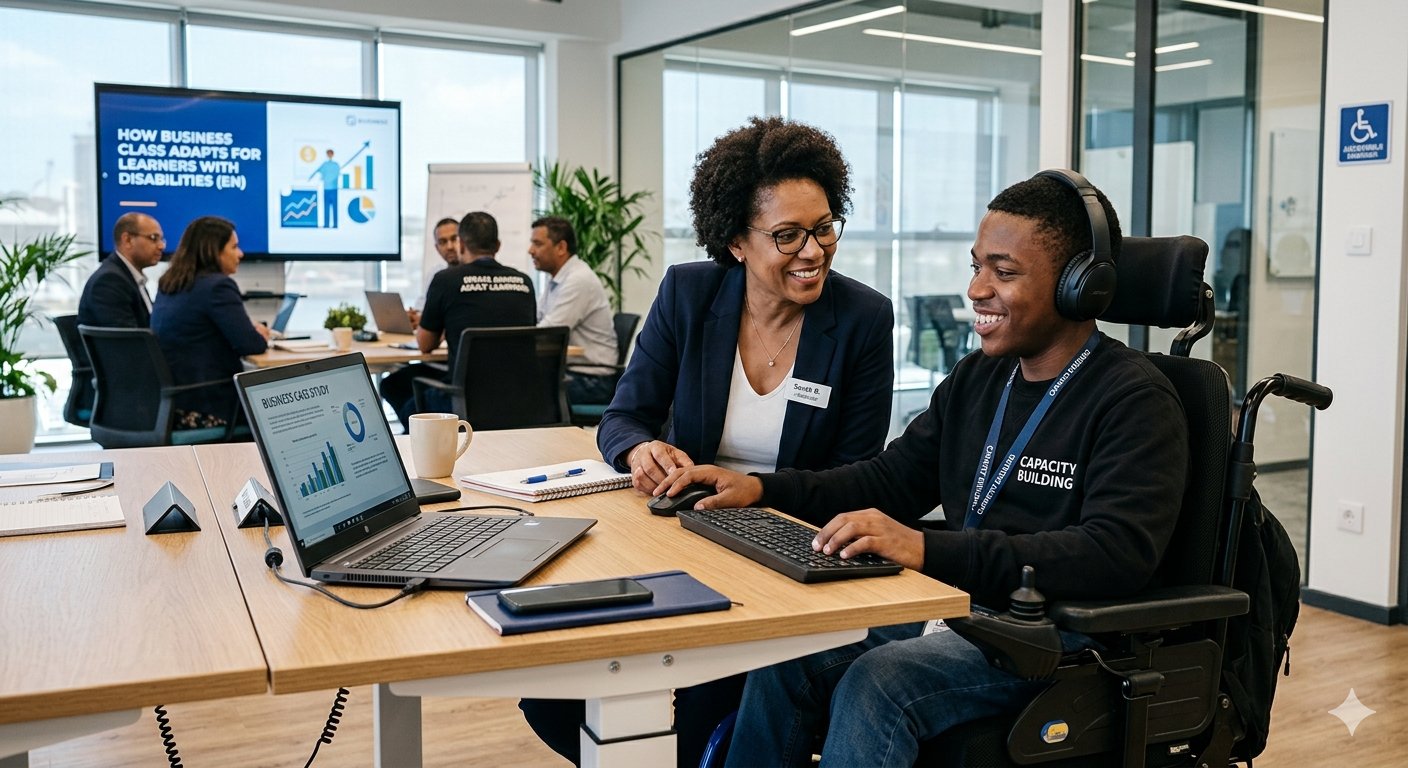
From time to time you may encounter a learner with a physical or learning challenge in your training session which may require some adjustments in order to optimize the learning environment. How Business Class Adapts for Learners with Disabilities
At Business Class Language Solutions, we have a reference person on staff dedicated specifically to this issue. Account Manager François Clais (François@business-class.fr) has that role (known in French as the ‘réfèrent Handicap’.) As such, he is here to assist a learner who has indicated a special need.
Once the learner declares a special need during registration, François will take contact with the learner and their HR Manager in order to understand how the training can be made more accessible.
For example, the learner’s desk may require a height adjustment, or the session length or number of course participants may need to be reduced. For official tests like the TOEIC, a learner may even be accorded additional time.
François has several ways of achieving these goals. He will first ask the employer to provide the technology or necessary adjustment, and if need be, he can also appeal to the French association AGEFIPH https://www.agefiph.fr/ (Association de Gestion du Fonds pour l’Insertion Professionnelle des Personnes Handicapées) for the financing to make the necessary material changes.
Advice From Fellow Trainers
On the trainer side, we are lucky to work with a team of professionals with diverse experience to draw upon. Four of them, Nicola Ailleris, Alan Caterer, Gerry Graham, and Tiger Hewitt have agreed to share their insights with us. Our goal is to provide you with a few tips to facilitate the training process with learners with disabilities. (Disclaimer: the advice and suggestions here are not meant to be construed as medical or psychological advice. )
Physical Challenges: Hearing Issues, Stuttering, Reduced Mobility
Hearing Issues
Nicola Ailleris explained that reassurance was key with a former learner with a hearing impairment in one ear. By acknowledging the learner’s bravery for his openness about his disability, she was able to establish trust with him. Nicola said, “He was very brave telling me.. It was good for our working relationship. It wouldn’t stop him from making progress.”
Nicola found the individual lesson easy to adapt and even suggested a blend of face-to-face and phone lessons. Surprisingly, she didn’t avoid listening exercises on purpose. “I wanted to give him confidence,” stated Nicola.
“On the phone, which was particularly challenging for him, I adjusted the volume and in person, I made sure to speak near his good ear, and let him read lips.”
Nicola continued, “When you’ve got hearing problems there are lots of lateral problems, and our lessons gave him confidence and helped with understanding. In the end, he was pleased he could do business with German customers every day.”
Nicola advises any trainer in a similar situation: “Be brave, an important adjective, and encourage the trainee to be brave, too. Try to create the atmosphere of trust right from the beginning. We all have things that stop us from learning, hidden blockages, and some people have things that they can’t hide. It’s important to be open about it and let them feel they can tell us about it so that we can help them to adapt to the conditions.”
For Gerry Graham
also suggests that when dealing with hearing impaired learners and in particular, lip readers, you might want to “to be sure they can see facial muscles not just lips” as this was more helpful for two hearing-impaired learners he trained in the past. In addition, make sure they can see your throat and neck muscles” as this facilitates understanding.
Tiger Hewitt reiterates that, “patience is the key,” to dealing with all learning challenges, and offers a helpful tip using technology. She suggests using closed caption functionality of tools, where available to provide an on-screen transcript to the conversation in your session. Simply open a new Google Meets meeting just for yourself, no need to invite participants if you are already connected via Zoom or even in a face-to-face situation. You may then split your screen and turn on closed captions and watch as both your speech and your trainees’ speech appear on screen. Tiger enthused that her learners particularly appreciate it when working on pronunciation.
Reduced Mobility
Gerry Graham also reminds us that when dealing with physical constraints such as a wheelchair, “take into account that a physical challenge may translate into a need for more time when writing, simply due to the physical constraint and not any learning challenge.”
He also recommends asking the learner themselves how they want notes to be handled. Do they want notes to be taken for them or to jot them down themselves? Asking the question empowers the trainer and learner to be open about their approach and keeps the learner in control of their experience.
Stuttering
Stuttering or stammering is a neurological issue that affects the learner’s ability to communicate their ideas fluidly. Gerry offers his learners an encouraging example of a successful person who overcomes this challenge daily, U.S. President Joe Biden.
Gerry also suggests asking learners to break down the sentence into breaths…” Gerry continues, “We don’t have a lot of punctuation in the middle of a sentence” and he encourages the learner to simply think: ‘ Subject / Verb / Complement / Stop’… “ and — if you want a longer sentence, add a linking word.”
Learning Challenges
When working with trainees with learning disabilities such as Dyslexia, Graham points out that you may notice that their response time is slower. Gerry suggests allowing time for the learner to understand the question. “ Be sure in the group that someone else doesn’t jump in;..give the challenged learner time to answer.” If they have dyslexia, they could also be eligible for extra time in testing situations
The Role of the Trainer
Also, Alan Caterer, who has had vast experience with physically challenged learners including time spent learning about music therapy, says that “compassion is part of it.” He affirms that this first experience in music therapy helped cultivate empathy which he has applied to language training ever since.
Afterwards, Caterer sees parallels between music and language learning. “Music is like language, really.” He asserts that in music, you let people improvise and similarly you can also do that in conversation. Caterer emphasizes the need for trainers to have skill in gently drawing out shy or reluctant people while keeping any dominant learners constructively active for example, by assigning them ‘helper’ roles. ”There are ways of encouraging people…it’s about finding the balance” he says.
Empathy, Patience and Compassion
The general consensus among our trainers is that the key ingredients are empathy, patience, and compassion, qualities that are generally fairly abundant in this profession. How Business Class Adapts for Learners with Disabilities
Advice for Less Experienced Trainers
When training special needs learners for the first time, Alan Caterer advises, “Don’t be judgemental. These people are no different than anyone else we train and that’s the thing to remember”
Basically. He continues: “ Be pragmatic. (Ask yourself) Are you a person that has empathy? Do you know when to stop talking? Do you know how to encourage people to speak? How to encourage people to ask questions when they normally wouldn’t. Keep It Simple!”
Go in with an open mind, even if they are really hesitant, be patient. Your efforts are sure to put your learner at ease and create a fruitful learning environment for both of you.
François Clais can be contacted at Francois@business-class.fr) Special thanks to Nicola Ailieris, Alan Caterer, Gerry Graham and Tiger Hewitt for their input to this article.

